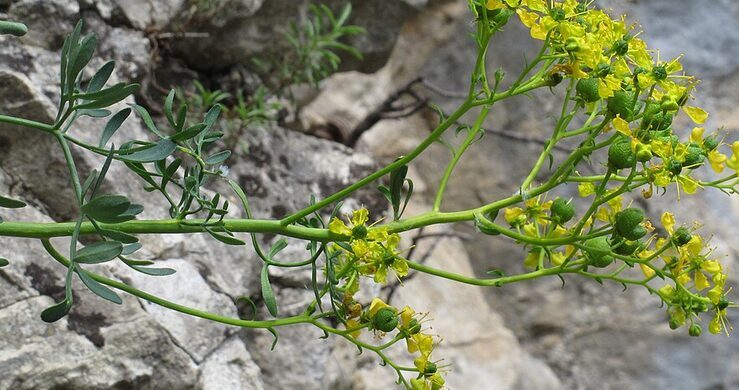
Something I have been trying to explore is writing more about my explicit experiences with spirit work, when doing so isn’t taboo or intrusive. Working with herbal spirits seemed like an easy entry point to this kind of writing, and so I have decided to write about my personal experiences with rue, one of my most open allies. It should go without saying that, while I cite several historical attestations here, my personal experiences are my own.
I didn’t necessarily set out to work with rue deliberately in my practice, though I was familiar with its use as a protective and curative herb. Rue is not necessarily the most culinarily useful plant to have in your garden, and until recently my garden was primarily culinary. But I tend to plant according to my whims, and rue inserted itself into my whims on contact when I was browsing herb starts at the farmer’s market looking at mints and lavenders.
The most prominent use of rue as an atropopaic herb is probably the cimaruta, from the Italian “cima di ruta,” literally “sprig of rue.” This is a composite charm using rue as the base, with magical charms or symbols at the ends of each branch of the sprig, used to avert the evil eye and protect against malefici. The plant itself was regarded as an averter of evil and a panacea against poison.
1800s folklorist Elworthy lists rue (among other subterranean plants/roots) as being among the most prominent Neapolitan amulets against malevolent magic in his 1895 work The Evil Eye1, cites Pliny’s belief that it could heal all manner of illnesses and poisonings, and mentions its possible role in religion owing to its folk name “herb of grace.” Culpeper (possibly the most influential herbalist of his time, and most notable in the occult for his herbal astrology) attests that rue is solar in nature and abjures poisonous plants, that is, that rue will not grow alongside something poisonous:
“Something is the matter; this herb and rue will not grow together, no, nor near one another: and we know rue is as great an enemy to poison as any that grows.”2
Despite all this, most people in my circles would probably think of it first as an abortifacient.3 While I do not recommend herbal abortion (in most cases there are safer alternatives), there is something to be said for the resurgence of interest in herbal abortion in certain contemporary circles, distributed through word-of-mouth and zines like Jeunet’s Reclaiming Our Ancient Wisdom, and engaging with the herb as a defender of body autonomy.
There isn’t much good for the body that someone, somewhere, won’t attest rue can do. For all this, it is itself poisonous in large quantities, beyond its role as an abortifacient, being both hepatotoxic and phytophototoxic.
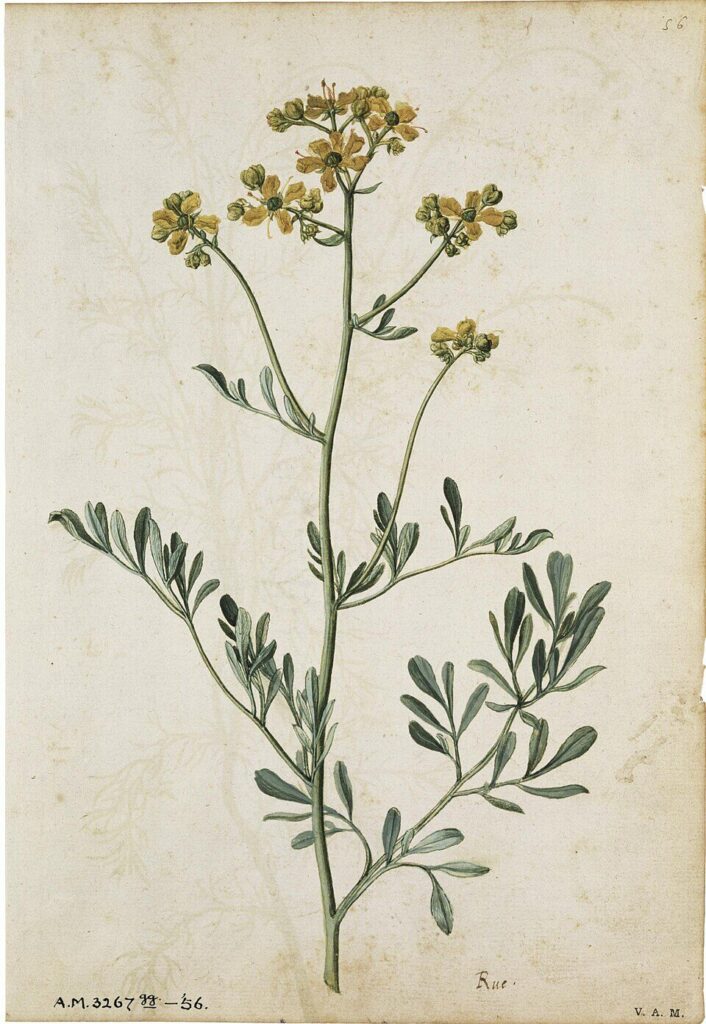
For all that it has a towering reputation, I try not to let folklore inform me overmuch, at least at first. It’s my policy to observe, then verify, in that order. It is generally much better when meeting a new person to meet someone at a bar and chat them up before looking them up online, rather than the other way around. So it went with me for rue.
The aspect of rue that drew me in so much was how much it seemed to want to work with me. I am not always the most tender gardener. Early in the planting season, I’ll sometimes wander around, sit and listen to the plants, and tell them I’m looking for new friends. (This is my chatting someone up at the bar, I suppose.) Most herbs are reasonably neutral. Some are aloof (I only this year managed to get any insight into basil). Rue jumped out at me, begging to meet me, asking to work with me. That kind of enthusiasm is rare, so I agreed easily and took a cutting home. A couple of weeks into the season, I was enjoying our relationship so much that I planted more.
To me, from the perspective of a plant-listener, Rue has a bright, welcoming quality, maybe more or equally martial as it is solar, a little sharp but not in an offensive way. If I were to describe her poetically, I would describe, perhaps, a tall, healthy young woman with long, sweeping hair, arms open for an embrace which might sting if one steps into it. It is sometimes valuable, as well, to distinguish between rue and Rue, between the spirit of the plant I prune and tend and harvest from and the spirit of the species, Ruta graveolens (et al), who works through all rue plants. I have four rue plants this year, and while they are all distinct rue plants, they are also all Rue, in the way that I am me and also human, and have my own character emergent from human nature. I often ask the rues how to harvest and tend them. I typically ask Rue how to work with her magically.
Given her apotropaic reputation, I was expecting Rue to have a harder character and to take an aggressive role in my life. I have not found this to be the case. While she has a protective feeling, it is more passive than active, maybe more of a healer than a fighter. Other plants (such as my citronella and geranium, at present) do more active spiritual protection work, warding against malevolent spirits and similar nasties. In the garden, Rue does more to filter and destroy ambient destructive forces and pests.
While I keep apotropaic sprigs in the house, Rue seems to be somewhat more preoccupied, in my own life and experience, with the personal: Personal attacks, forces targeting the body, parasites, and so forth. I keep a small sprig on my person in my wallet as a hidden amulet, but if I want to engage with Rue directly as a protector, I have been invoking it through ingestion.
Principally, I ingest rue in Ethiopian-style coffee by simmering it in milk before adding it to the latte. By literally taking rue into myself, I can carry some of its qualities. On deliberate invocation, I perceive this as an herbacious feeling in my own spirit, a welling-up of rue-quality, through which maliciousness and harm cannot pass. Ideally I would like to drink rue coffee before doing any heavier banishing or dismissal ritual to catch and destroy any stray influences on me. There are some places that I will not go without some form of magical protection, and because of our established relationship and agreement where she may work through my body in this way, this is among the tools that I can now look to.
Finally, there is an effect that it works on me when I sit with it, just as I work on it. I alluded earlier to its potential role as a defender of body autonomy, and I have found my rue to be very aligned to liberation. It does not like bindings laid on me or on the space it is in, and naturally erodes them with its presence. Maybe “erosive” is the word I’ve been looking for, trying to describe its martial qualities: Not pointy like a sword, but like sandpaper. It does not reach out, but destroys in being touched.
It erodes binding and constricting currents on the house ambiently simply by working on my behalf in the garden. It is also possible to take a bundle of sprigs, ideally fresh, to dip them in water, and to use the leaves to anoint the home or any other structure which has bindings which one wants to break. Its direct touch is powerful for this purpose (though be mindful of its phototoxicity).
Rue has become a quiet mainstay companion in my workspace, and I feel closest to it when sitting with it in the garden, feeling it go to work on me. In my experience, it is a plant that very much wants to work with those who would be a willing partner.
- Elworthy, F. T. (1895). The Evil Eye: The Origins and Practices of Superstition by Frederick Thomas Elworthy, in turn citing Nicola Velletta’s Cicalata sul fascino volgarmente detto jettatura. Freely available on Sacred Texts. ↩︎
- Culpeper, N. (1653). Complete Herbal. Freely available through Project Gutenberg. Incidentally, “this herb” in this passage is basil, which he held to be poisonous. ↩︎
- Moran, B. T. (1993). “Early Abortifacients.” Pharmacy in History, Vol. 35, No. 2. Available through JSTOR. But rue’s reputation as an abortifacient is widely known. ↩︎
The featured image of R. graveolens was taken in 2012 by Robert Flogaus-Faust.
