The most popular method of developing sigils that I see everywhere in the magical community was first proposed by occultist and proto-chaos magician Austin Osman Spare in 1913’s The Book of Pleasure. If you have ever looked up “how to create a sigil,” you have likely read something derived from this method:
Sigils are monograms of thought […]; a mathematical means of symbolising desire and giving it form that has the virtue of preventing any thought and association on that particular desire (at the magical time), escaping the detection of the Ego, so that it does not restrain or attach such desire to its own transitory images, memories, and worries, but allows it free passage to the sub-consciousness.
Sigils are made by combining the letters of the alphabet simplified. […] The idea being to obtain a simple form which can be easily visualised at will, and has not too much pictorial relation to the desire. […]
Now, if for some purpose, you wanted the strength of a tiger – you would make a sentence such as “This [is] my wish to obtain the strength of a tiger.” Sigilized this would be: […]
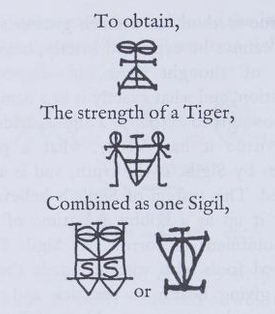
Now by virtue of this Sigil you are able to send your desire into the subconsciousness (which contains all strength)…1
This methodology was revised and popularized in Peter J. Carroll’s seminal chaos magic work Liber Null and Psychonaut:
Sigils work because they stimulate the will to work subconsciously, bypassing the mind.
There are three parts to the operation ofa sigil. The sigil is constructed, the sigil is lost to the mind, the sigil is charged. In constructing a sigil, the aim is to produce a glyph of desire, stylized so as not to immediately suggest the desire. It is not necessary to use complex symbol systems. [This image] shows how sigils may be constructed from words, from images, and from sounds.2
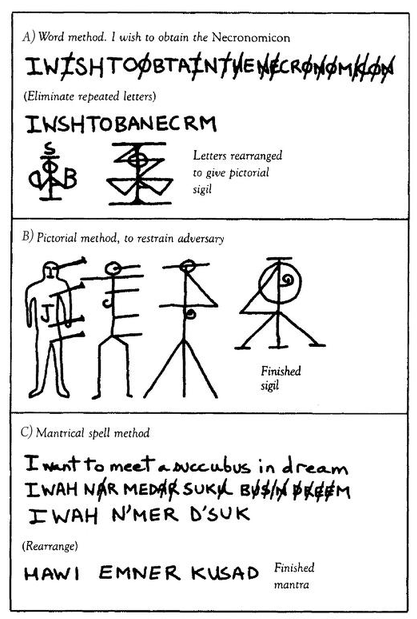
There are several things that I find interesting about the contemporary prevalence of the letter-reduction method. One is that this sigil methodology has a firm foundation in chaos magic, using thought and belief as deliberate magical tools, and the majority of witches and magicians I’ve met who use this method would not call themselves chaos magicians and often do not know what the source of this method is. Compounding this factor, many magicians (especially neophytes) are not aware that this method has a chaos magic-based method of action: That the sigil’s origin must be deliberately forgotten, for one, let alone the classical ideas on how to charge them (namely through trance, orgasm, desire, or strong emotion). Finally, it is interesting to me that the letter reduction method has seen wide adoption, while the pictographic and mantric methods go largely unused in popular witchcraft spaces.
Regardless of the chaos magic-specific belief system, one assertion from the above writings is readily apparent: A sigil is an abstraction. It necessarily creates a barrier between observer and observed, a semiotic signifier.
Spare’s method is far from the only method of constructing sigils. Naturally, sigils and their magical use outdate Spare by thousands of years. Among the historical approaches to magical sigil construction, several come to mind as examples: numerological methods, astrological methods, and runic methods.
Interestingly, runic methods are the most similar to Spare’s. Runes, which are each both letter and sacred mystery, can be recombined as a bindrune. It is unclear to us today the extent to which this technique was used in magic, and researchers disagree; as Mindy MacLeod speculates:
Bind-runes occur most often in the early texts in the ubiquitous ek erikaR/irilaR formula […] Veblungsnes & By. Birkmann (1995: 157) has suggested that this ‘Modeerscheinung’ may have promoted the use of bind-runes, perhaps linked with magical practices, in other inscriptions, particularly the ek… inscriptions. Given that several bind-runes pre- and post-date the fifth and sixth century erilaR inscriptions, there is little concrete support for Birkmann’s theory of a bind-rune fad possibly linked with magic. […]
I think it is safest to maintain that there is no general underlying principle governing the use of bind-runes: like ligatures in other scripts, they were used to save time, space, or effort [… and additionally] sometimes used as a kind of decorative flourish to alert the eye to a signficant part of the inscription.3
However, this passage brings to mind one of the most famous examples of runic inscription: the Lindholm amulet, dated between 375CE and 570CE, which follows the above described “ek…” formula, which is to say, the inscription begins (translated) “ekerilaR.”

In the very same collection, Stephen Flowers writes:
This object has been much discussed in the context of “rune-magic” [citing Olsen (1916), Linderholm (1918), Sierke (1939), Krause (1966), Nielsen (1985), and Flowers (1986)]. It is a piece of animal bone carved to resemble a rib-like shape and provided with zoomorphic features. The shape is not unlike other amuletic [safeguarding against harm] found in various cultures and among other runic inscriptions. The object had apparently been deposited in a moor sometime around 500 CE. It was accidentally cut in half when it was discovered in 1840 in the course of cutting peat from the bog. This damaged one of the runes to such an extent that it can no longer be read. Besides this unfortunate accidental problem the only peculiarity of the forms of the runic characters is that they are all made with three (and in one place four) parallel lines. This is a multiple-stroke graphic tradition shared by the Kragehul inscriptions which date from the same time as the Linholm bone.
The runes read:
A: ekerilaRsailagaRhateka***
B: aaaaaaaaRRRnnn-bmuttt**alu***Line A has been variously interpreted as ek erilaR SawilagaR ha(i)teka (“I, ‘the eril’ am called PN”) and ek erilaR sa wilagaR ha(i)teka variously translated as either “I ‘the eril’ here an called the crafty one” or “I ‘the eril’ am called the one who knows magic” […]
Vilir: ‘very crafty one’ is an Odinsheiti [name or epithet of Odin] which reminds us of wilagaR. Vilir may be derived from [Proto-Germanic] *wih-l-, a term connected with sorcery and religion in Germanic. It is not unthinkable that WilagaR actually refers to a god (*Wodanaz?) and only secondarily to the rune-master. […]
The third and final part of the formula consists of the word alu which occurs well over a dozen times in the corpus of the older runic inscriptions in all sorts of contexts. The word clearly belongs to the technical operative vocabulary of the Germanic peoples and originally referred to an ecstatic mental state as transferred to a potent drink (alu(p)-: ‘ale’) used in religious rituals. The formulaid word seems best understood in the inscription as an operative utterance meant to infuse the inscription (or object) with power, and to separate it from the profane world — to render it sacrosanct.4
The use of bindrunes in historical objects which have strong evidence of magical or ritual use and probable association with the mythological giver of runic mysteries, *Wodanaz (also Woden, Odin), opens up some possibilities. Flowers additionally goes on to compare runic formulas to the logoi of the Papyri Graecae Magicae5.
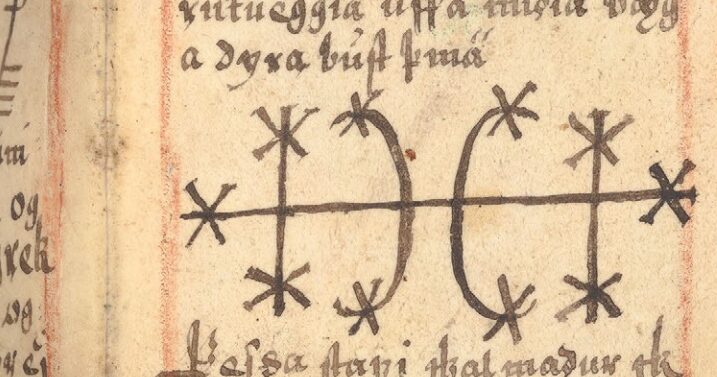
Over a thousand years after the Lindholm amulet was carved, galdrastafir, or Icelandic magical staves, were first documented in ~1600 CE in Icelandic grimoires, namely the Galdrabók, which variously invokes Norse and Christian entities6. The most famous (and charismatic) of these are the vegvísir and œgishjálmur (“Helm of Awe”), which are sometimes referred to as bindrunes by contemporary magicians.

Some assert that the Icelandic staves are bindrunes using the futhark/futhorc rune family, but while some may be visually bindrune-like, this seems unlikely. Many staves seem to have little to no analogue to any futhorc alphabet, at least some seem pictographic in origin (e.g. the angurgapi), and indeed one, the “Sigil of Salomon,” appears to be a direct analogue of the Seal of Solomon7.
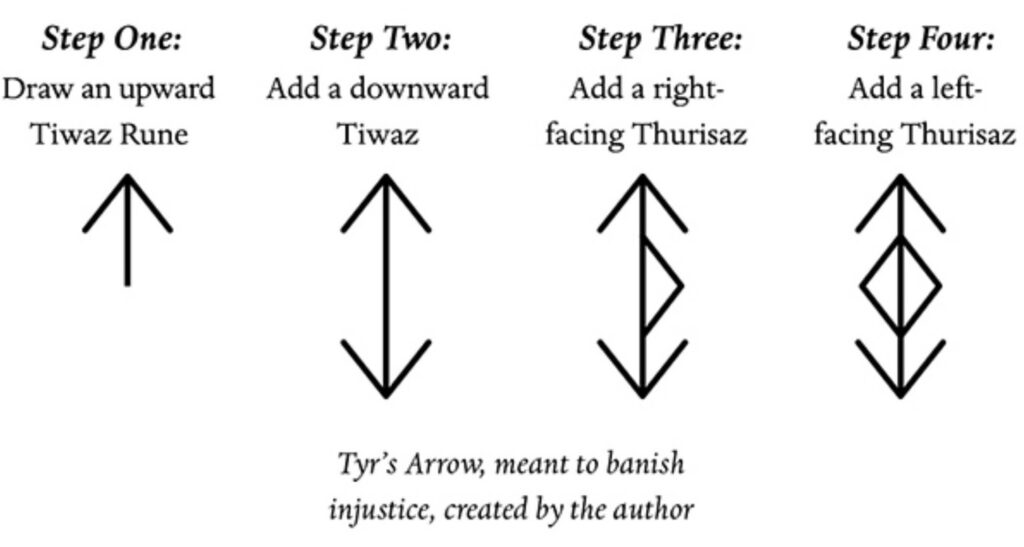
Regardless of the historical use of bindrunes, contemporary practitioners do leverage them as a magical method, and given that the runes are an alphabet (and indeed an alphabet comprised entirely of symbols of sacred mysteries) this method is helpfully similar to Spare’s. For example, Ryan Smith in his introductory text on Radical Norse Paganism teaches this technique using a simple bindrune called “Tyr’s Arrow,” comprised of the runes Tiwaz (T) and Thurisaz (TH)8:
By contrast, many sigil construction methodologies do not leverage alphabetical construction at all, but rather numerological construction.
Many sigils and seals, in Western esotericism and otherwise, incorporate numerology. This is readily visible in the various uses of the triangle, hexagram, pentagram, heptagram, and other numerically important constructions. Consider the use of the hexagram in the Seal of Solomon9, the use of numerology in the Pythagorean tetractys10, and the layered use of geometric forms in the Sigillum Dei.

Of these seals, many leverage geometric and mathematical forms as a format onto which additional information is imposed. The Sigillum, above, includes the names of God and angels and letter transcriptions linked to astrology. Likewise, Solomonic pentacles, based in astrological tradition, frequently include Hebrew scripture, the names of God, astrological symbolism (such as sigils of the planetary intelligences), and explicitly pictographic symbolism (as seen in the scorpion in the Fifth Pentacle of Mars or the angelic depiction in the First Pentacle of the Sun).11
This begs the question of whether such a seal actually qualifies as a sigil, if we agree that a sigil is an abstracted layer between user and meaning. In my opinion, this depends entirely on the construction of the seal and the level of abstraction it represents to the user. However, the various influences on the construction of these pentacles can be informative regarding the different approaches that can be used to construct a magical symbol.
The mathematical approach that practitioners are more likely to be familiar with is the use of “magic squares” or kameas. Though the exact provenance of this technique in Western esotericism is difficult to ascertain, this technique was popularized by Agrippa, who probably learned of it through his mentor Johannes Trithemius12.
A magic square is an array where the sum of each row and column is the same. The first magic square, of 3×3 arrangement, was discovered and used in China where it was first documented in the Da-Dai Liji (“Record of Rites by the Elder Dai”), where it was used primarily for astrology and divination13. The use of magic squares to construct sigils likely originated with Agrippa, where each magic square, or kamea, is given an astrological correspondence: the 3×3 is of Saturn, the 4×4 of Jupiter, the 5×5 of Mars, and so forth. This allows magicians who work with astrology to mathematically develop sigils out of astrological correspondences. David Rankine describes and criticizes Agrippa’s method:
Returning to Agrippa, and the technique he used, the Hebrew names of beings such as the Planetary Intelligences and Planetary Spirits were transcribed onto the kameas, the sigil being formed by drawing lines joining the squares corresponding to the numerical values of the letters in sequence. The numbers attributed to the letters were used according to the range of numbers within the kamea. If the letter had a higher number attributed to it than existed in the kamea, the number was dropped to the highest number available in the Aiq Beker table. As the largest kamea is that of the Moon, which has the number range 1-81, any letter with a numerical value over 80 would always be reduced. […]
Confusingly, in the first source for this technique, Agrippa’s Three Books of Occult Philosophy, Agrippa himself does not seem to always stick to these principles in the construction of the sigils for the Planetary Intelligences and Spirits. For instance where a word contains the letters IA together, which is common in names of spiritual creatures, the numerical values of the letters, I=10 and A=1, are often added to make 11, instead of using the squares for 10 and 1. Likewise he sometimes combines other letters with no apparent reason, and does not always reduce a number to the highest value, e.g. reducing 200 to 2 instead of 20 when there is a 20 in the kamea.14
This method was used to derive Agrippa’s sigils of planetary intelligences, which have now been reproduced ad infinitum across Western occult spaces, and which indeed do appear within the Solomonic pentacles themselves. It has the advantage of being very clear and objective, and will align with certain forms of ceremonial tradition much easier than other methods. It also has the disadvantages of having little room for subjective manipulation and editing, as well as potentially producing very similar sigils over a long enough span of time. If the same technique is applied the same way for the same purpose, multiple practitioners will theoretically always arrive at the same sigil–an effect which may or may not be desired. Regardless, it has the same effect of other sigil construction techniques: It imposes an idea or desire onto an abstracted form.

.jpg)
There are many contemporary works of art that could be considered sigils, though they do not enjoy a magical tradition as the above techniques do. For example, Pennsylvania Dutch barn stars, or “hex signs,” have a reputation as magical or apotropaic symbols, despite historically having effectively no basis for this reputation15. However, contemporary practitioners in the region such as Hunter M. Yoder have taken up the craft as a heathen magical act and use them in the same abstracted way as traditional sigils. Additionally, Laura Tempest Zakroff16 has also gained popularity for her technique of developing sigils from a set of meaningful symbols to the user (such as hearts, stars, eyes, arrows, etc.). Other practitioners also channel sigils and symbols through spirits using methods aligned to their spiritual traditions, use them as mediums to call or summon gods and spirits, or otherwise use them as tools to more directly interface with the spiritual.17
To circle back to chaos magic, this sigil-as-abstraction approach can be taken to its logical extreme: Any deliberate form of abstraction can be used as a sigil. Chaos magician Grant Morrison famously described his work The Invisibles as a “hypersigil,” a tool through which he enacted his magical will through the magical application of narrative composition and artistic execution:
The “hypersigil” or “supersigil” develops the sigil concept beyond the static image and incorporates elements such as characterization, drama, and plot. The hypersigil is a sigil extended through the fourth dimension. My own comic book series The Invisibles was a six-year long sigil in the form of an occult adventure story which consumed and recreated my life during the period of its composition and execution. The hypersigil is an immensely powerful and sometimes dangerous method for actually altering reality in accordance with intent. Results can be remarkable and shocking.
Experiment:
After becoming familiar with the traditional sigil method, see if you can create your own hypersigil. The hypersigil can take the form of a poem, a story, a song, a dance, or any other extended artistic activity you wish to try. This is a newly developed technology so the parameters remain to be explored. It is important to become utterly absorbed in the hypersigil as it unfolds; this requires a high degree of absorption and concentration (which can lead to obsession but so what? You can always banish at the end) like most works of art. The hypersigil is a dynamic miniature model of the magician’s universe, a hologram, microcosm, or “voodoo doll” which can be manipulated in real time to produce changes in the macrocosmic environment of “real” life.18
A hypersigil, in short, can be almost anything. It speaks to the abstraction not just of line, shape, form, or sound, but to the abstraction of narrative, in the way that Aesop’s fables communiate human morals. A book, story, article, blog, website, poem, artwork, building, garden, map, choreography, song, meal, chore, name, or any number of additional formats could be a hypersigil.19
This mirrors many maxims in witchcraft and the occult. “As above, so below; as within, so without.” As imaginal, so real; as abstract, so concrete. By constructing a narrative where we put pins in a poppet to harm our target, or bind a meat animal’s tongue to stop our target from speaking ill of us, so we can impose magical narratives onto reality using sigil construction.
- Spare, Austin Osman. (1913). The Book of Pleasure. Available on Archive. ↩︎
- Carroll, Peter J. (2022). Liber Null and Psychonaut: Revised and Expanded Edition. Available on Archive. ↩︎
- MacLeod, Mindy. (2026). “Ligatures in Early Runic and Roman Inscriptions.” Runes and Their Secrets: Studies in Runology. Museum Tusculanum Press. See Google Books. ↩︎
- Flowers, Steven E. “How to Do Things with Runes.” Ibid. ↩︎
- The Greek Magical Papyri, or the PGM for short: a collection of magical manuscripts from ~100 BCE to ~400+ CE, and one of the best-known examples of pagan magic in antiquity. See Betz’ The Greek Magical Papyri in Translation. ↩︎
- The original Galdrabok is available from the ALVIN archive. It was first translated by Stephen Flowers in 1989 and there are other English versions available. ↩︎
- Available for perusal at the Icelandic Museum of Sorcery and Witchcraft. ↩︎
- Smith, Ryan. (2019). The Way of Fire and Ice: The Living Tradition of Norse Paganism. Llewellyn Publications. This particular form of contemporary Norse paganism is notable for its dedication to antifascism and mutual aid and is considered an introductory guide by antifascist heathen organization The Troth. ↩︎
- The Seal of Solomon predates the Star of David and likely came from Arabic tradition. See an example of 11th century Islamic talismanic use here courtesy of the Met Museum. ↩︎
- Guthrie, Kenneth Sylvan. (1987). “The Tetraktys: Number as Paradigm.” The Pythagorean Sourcebook and Library. Phanes Press. ↩︎
- Mathers, S. Liddell MacGregor. (1889). The Key of Solomon the King (Clavicula Salomonis). George Redway. Available just about anywhere, but here is a link to Sacred Texts. ↩︎
- Johannes Trithemius was also known to be the mentor of Paracelsus. ↩︎
- Yoke, H.P. (2008). “Magic Squares in China.” Encyclopaedia of the History of Science, Technology, and Medicine in Non-Western Cultures. Springer, Dordrecht. doi.org/10.1007/978-1-4020-4425-0_9350 ↩︎
- Rankine, David. (2024). “Agrippa and the Magic Squares.” Publically available. I recommend looking deeper into this for more information on kamea sigil construction because explaining planetary numerology is outside of this scope. ↩︎
- Donmoyer, Patrick. (2013). Hex Signs: Myth and Meaning in Pennsylvania Dutch Barn Stars. Pennsylvania German Cultural Heritage Center. ↩︎
- Probably best known online for her Sigil for the Protection of Transgender Rights. ↩︎
- Describing the multitude of ways that sigils and similar symbols can be used in tandem with spirits is out of the scope of this work, but consider the role of the veve in Vodou, demonic sigils in demonolatry, or the use of the true name in Egyptian mythology, Abrahamic grimoire tradition, and fairylore. ↩︎
- Morrison, Grant. (2003). “Pop Magic.” Book of Lies: The Disinformation Guide to Magick and the Occult. Disinformation Company. ↩︎
- If you’re reading this on my website, whether you know it or not, you’ve seen a hypersigil! ↩︎
Featured image is from the galdrabók scan in the ALVIN archive.