Not having read tarot professionally for more than a decade, I made the jump back in in possibly the most ill-advised but fun way possible: Doing a five-hour shift in a free-plus-tips reading booth for the Witch’s Carnival, a fundraising event put on by my friends in the local scene.
I don’t see any shame in admitting I was nervous leading up to it. My own work lately with the tarot has largely been spiritual–focusing on getting answers about things I can’t see with my own eyes, like spirits and magical workings–and even when I did read tarot for pay, my audience back in the day was largely other witches and pagans. By contrast, I knew that offering free readings at a public event would be a very different beast. Many people had a reading who had never had one before, and were curious but had never made the jump to pay for a reading. Many others would be excited to have a reading for free, but have no question in mind when they walked up. (And despite knowing this, I still didn’t anticipate just how long the line would get.) So to solve this problem, I developed a “menu” of possible spreads alongside my normal ground rules.
My normal rules apply, as always: No readings if you don’t want to know the answer, no love readings if both or all parties are present, no lying even if the outcome looks bad. And there are a few good ground rules for the carnival setting, too, given the loudness, the crowd, and the levity of the setting: No readings about current events, nothing involving direct spirit channelling (e.g., no talking to your dead grandmother), and nothing over three cards. I was initially willing to bend this last rule for the right question, but with the line I ended up encouraging even more single-card draws than normal.
Though I brought backups, the deck I chose to use for this setting was the Divine and Play Tarot. Both a tarot deck and a playing card deck in a traditional playing card size, I can use this for playing cartomancy as well, though I didn’t do so. More pertinently, I felt that this deck would hold up well to public handling. My hands don’t always cooperate when I shuffle, and so my personal method for shuffling involves a lot of cutting and piling, but this method can be slow, which isn’t ideal when you’re doing many small readings. The smaller card size helps (though the thicker deck size hinders)–but just in case my fingers weren’t having it, I wanted a deck that I would feel comfortable letting a stranger shuffle. I have more strict deck hygiene than a lot of my peers that differs from deck to deck, and no one is allowed to touch my usual deck but me.
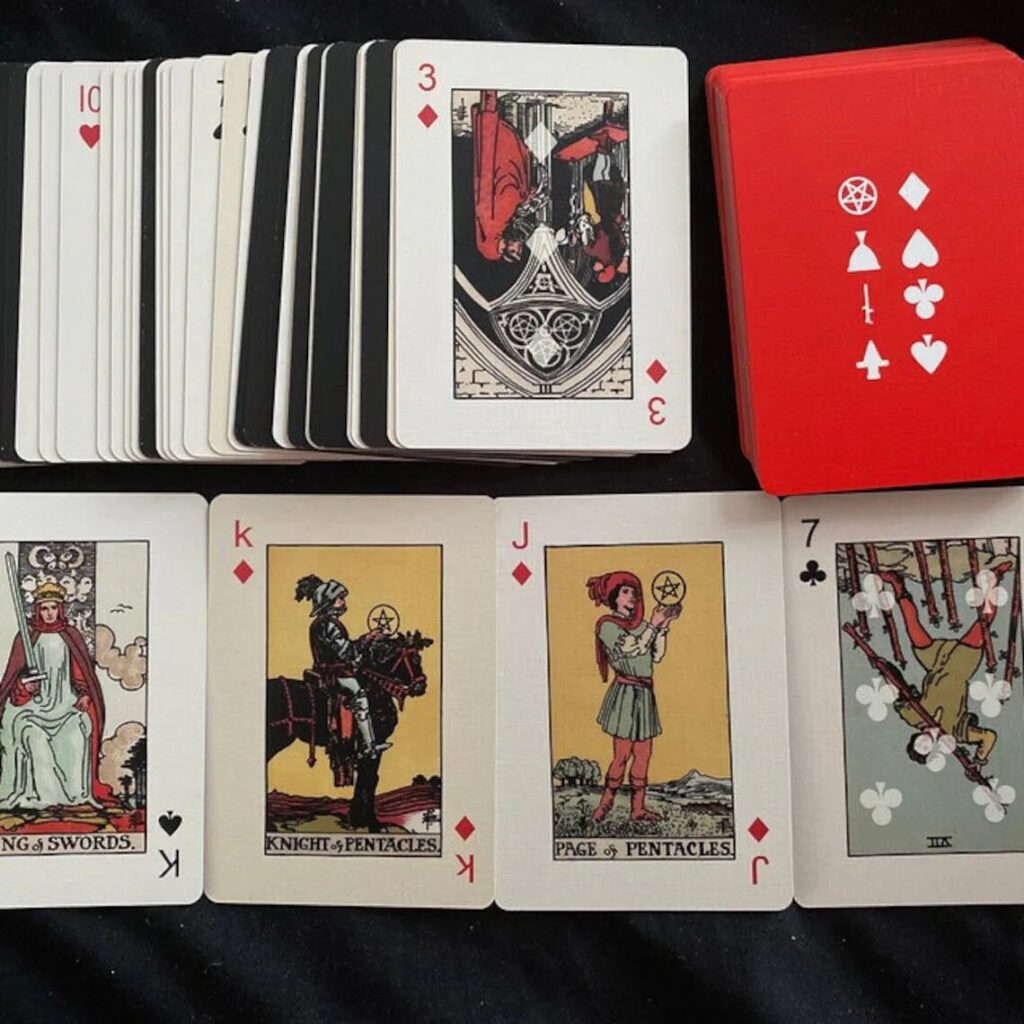
(I do feel that the deck held up well to others’ touch, but the cards remain in the “cool off zone” in my cleaning-box until I can wash them.)
With this in mind, my drawing technique changed quite a lot as the day proceeded. I started with full shuffling and drawing from the top early on, but as things picked up, I would cut the deck, spread it over the table, and let querents choose the cards by hand in order. It turns out, I just generally don’t like people touching my deck no matter what, so I moved instead to cutting, spreading, and choosing the cards myself, which was the quickest. I think that in a different setting, I would still be open to letting querents touch this deck, but at least thirty people must have touched these cards, and that was too much for me in one day without cleaning them between. (Some people are going to be less picky; that’s fine, but I am.)
I do still think it’s important to draw the querent into the reading and get their participation, though. It would have been easy to take this less seriously, pre-shuffle before hearing the question, being very clinical about meanings, and so forth, but I simply can’t turn that off. Instead of choosing the cards, I prefer to get participation by walking the querent through phrasing their question, and then vocalizing aloud what I’m thinking for a spread. Often, for those without a specific question, I would give them two options: One general forecast card “to go home and chew on,” or a three-card spread containing a theme for the month, energies in, and energies out. I expected to do more past-present-future, since it’s the tarot reader’s bread and butter, but casual querents don’t seem to respond as well to this (since, for example, it must be explained that the past is not just one card to represent their entire past but something in their past that is carrying forward, and so forth). Most rarely, I did a two-card choice outcomes, something for which I’d normally do a larger spread, for those with very clear should-I-or-shouldn’t-I questions; I generally don’t want to position myself as advisor or counselor, so answering those questions with a yes or no is not how I prefer to go about things.1
On that note, I’ve chatted with peers extensively this past week about the nature of non-spiritual tarot readings for others: To be a good reader, someone querents will be happy to return to, you virtually must position yourself as a kind of micro-therapist. Half of the task is talking someone into their question and then talking them through the interpretation of the answer. For most people, tarot is the work of reflecting on your own position and resources and forcing yourself to look at it sideways. It is an easy container in which to talk about your problems for a moment with a kindly stranger.
A friend who briefly took over for me while I fetched a drink for myself does not enjoy giving tarot readings, which he says is because people don’t really want to hear the truth. While I think I have more of a bedside manner, so to speak, I’d tend to agree with that. The thing is, it’s hard to look at someone’s career prospects and see a dead end, or look at their personal lives and forecast a breakup or a big argument. I think I have more of an ability to put it gently than my friend; “your career prospects look bad” can be gently reframed to “look realistically at your resources and what you actually want for your future,” rather than “copywriting is a nightmare in the current job market, what are you thinking?”2 Especially not at a carnival to someone who had a reading done on a whim. During almost every reading, I’d find myself asking “are you familiar with tarot?” just to see how hard it would be to explain that, for example, I didn’t love seeing the Sun in the receding-energies position.
As a final consideration, something I was worried about was how exhausting it would be. The emotional aspect wasn’t too tiring–the crowd seemed to agree with me that this wasn’t the setting to be asking deep existential questions. But the actual magical aspect of reading cards can be very draining. I don’t feel that this is very well talked-about in tarot-specific spaces (as opposed to magical ones), and part of that may be because tarot does not always have to be magical, and even when it is it does not have to be “deep work.” I don’t know how to turn it off per se, but I still tried to balance this by not tapping in “too deeply,” as it were, and instead letting my intuition take the driver’s seat, which is sufficient for the vast majority of readings about things like money, career, and relationships. I was still very tired by the end of the carnival, and feeling it in my body as a disproportionate weariness. In a perfect world, a slower crowd would probably be better for me, but it’s hard to complain about a huge crowd coming out to a benefit.
That aside, I feel the session went very well. Many people tipped me fairly generously afterward. One person led her friend over, excitedly telling her how I’d been so accurate. An old woman said my little three-card interpretation was so on-the-money that it set her hair on end. I made a young girl smile during her first tarot experience. A teenage boy shyly had his fortune told, then came back at the end of the day with his mother and asked if I could do a reading that he would translate into Spanish for her. I remembered, for a moment, what I like about reading cards for others–that feeling of cooperating with them from across the table, and leaving them with something meaningful to think on.
- You often see the same thing with oracular seidr: People often just want advice, or to offload the pressure of a big decision. This is fine, but I won’t tell people what choices to make in their lives. ↩︎
- I have been wondering if the majority of questions being about jobs and money is a recession indicator. ↩︎
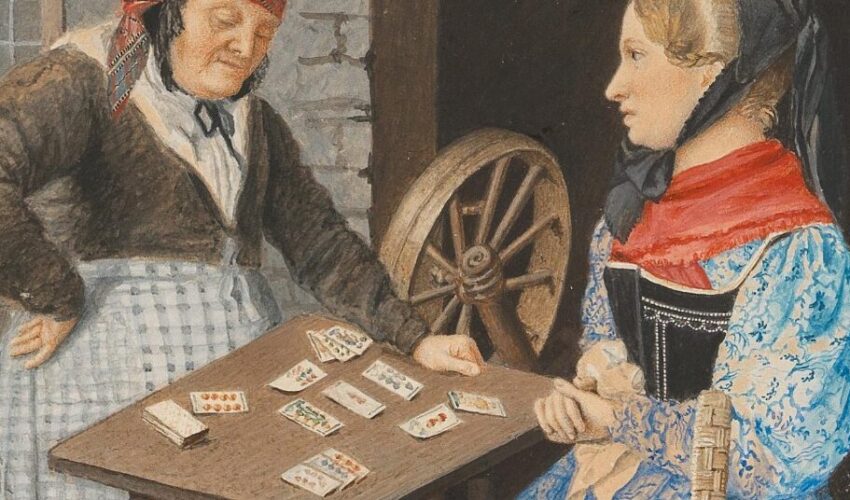
Featured image is At the fortune-teller by Amalie Peter, via Dorotheum.