I have found that the court cards are often the least-understood cards to tarot novices.
Simply memorizing card meanings is how many people learned tarot, but it is far from the most efficient method. Confounding this, the card meanings of the court cards are complex and often vary from author to author and interpreter to interpreter. Frameworks exist for understanding tarot systematically, such as narrative frameworks or pairing suit and numerology, but these systems often neglect the court cards. To this end, I am going to present a simple framework for interpreting court cards systematically.
This framework looks at the role of a card as a method of action, or verb, and the suit of a card as a theme, or noun. This results in a simple verb-noun pairing that is an excellent starting point for card interpretation which relies on symbolism and themes rather than rote memorization.
This is my personal framework. I am sharing it because I think it will encourage newcomers to develop systems of understanding, but I encourage readers to actively consider whether they agree or disagree with my interpretation of the elements of the system, and revise their own systems to suit themselves. It is also deliberately ungendered.
The included interpretations also assume an RWS deck. If you don’t use an RWS or RWS-styled deck with the same symbolism, follow along with the methods for discerning your own interpretations.
What are the court cards doing?
The interpretation of the court cards that I was first taught was that they represent people. Typically, within this framework, kings are men, queens are women, pages/princesses are children, and knights/princes are youths, teenagers, or young adults (or pages/princesses are female children and knights/princes are male children).
Beyond presenting obvious problems with binarism, I align with a more archetypical or role-based interpretation. If the Page of Swords is a student, for example, then in a spread about myself it likely represents myself stepping into a student role. Similarly, this framework is useful for doing readings on spirits. I rarely care about the perceived gender, age, or appearance of a spirit; much more often I care about the role it is playing in my life and in the ecosystem in which I encountered it. It is a much more flexible approach.
Using this approach to interpretation, there is an opportunity to present a system for understanding the court cards that starts from the standpoint of synthesizing symbolism and works naturally to its meaning, rather than telling the novice or student an arbitrary meaning and expecting them to memorize it.
Roles as Methods of Action
To begin with, consider each role as a method of action that will act on its suit. We can synthesize this method of action into a verb.
I like to encourage people to apply their own interpretations to these cards. Go through your tarot deck and remove each of one suit–the Kings, for example. Line them up in a row. What do you feel when you look at them? What is the same for each member of the group? What is different? Look at how the members of the group are posed, what they are holding, where they are looking, and interpret how they are feeling. What common themes do you identify?
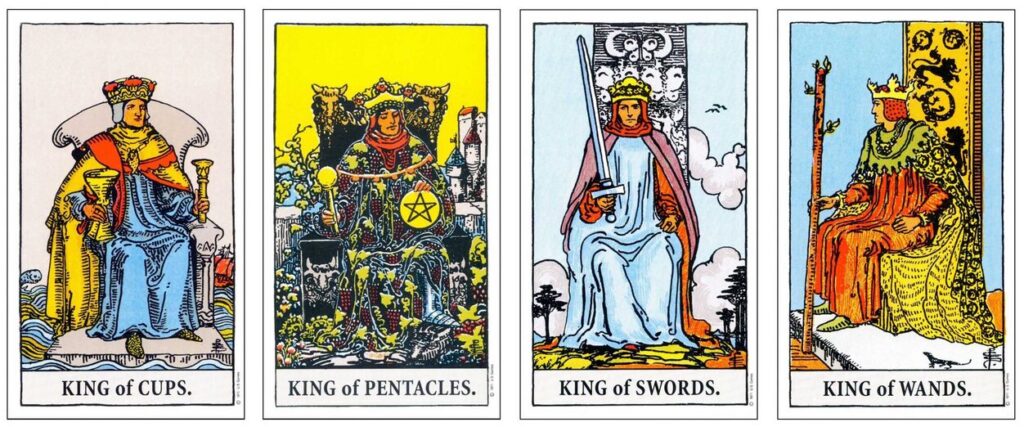
I would encourage you to dismiss the notion of gender altogether when evaluating the court cards for this purpose. The Queen is not an expression of “feminine power,” for example: It is a methodology which anyone of any gender can use.
Some interpretations:
The King rules from above. The lawgiver, controller, politician, and leader, the King imposes order and exercises mastery over his suit. He demonstrates outer mastery. He might be read as a lower “octave” or echo of the Magician, Emperor, or Hierophant. Its verb is “controlling” or “mastering.”
The Queen rules from below. The mediator, nurturer, influencer, and alchemist, the Queen steers the suit from the perspective of manipulating it from within, as opposed to imposing order from without. She demonstrates inner mastery. She might be read as a lower octave of the High Priestess, Empress, or Hierophant. Its verb is “nurturing” or “mediating.”
The Knight acts on its power. Rushing, changing, fueling, and charging forward, the Knight expresses the power and ambition of its suit. It is volatile and aggressive. Its verb is “acting on” or “changing.”
The Page is initiated into its power. Beginning, learning, planting, and growing, the Page is initiated into and is a student of its suit. It is stable and receptive. Its verb is “beginning” or “growing.”
A quick note about elemental associations. Each court card is also naturally aligned to a suit: The King is air (swords), the Queen is water (cups), the Knight is fire (wands) and the Page is earth (coins). For this reason, four court cards are also elemental masters of their suit: the King of Swords, the Queen of Cups, the Knight of Wands, and the Page of Coins1. If you do work with elemental interpretations, this can be a useful additional framework, especially when using court cards as spirit identifiers. (If you don’t work with elemental associations, throw this part out.)
Suits as Themes and Nouns
When developing your own interpretations of the suits, I would encourage you to do as above where you draw from each suit, but this time, draw the Ace of each suit. The Ace is like the wellspring or origin of a suit, reflecting its essence. Compare and contrast them. How does each make you feel? What are the symbols in each? For each, identify a one-word noun that reflects the theme of the suit from your perspective.
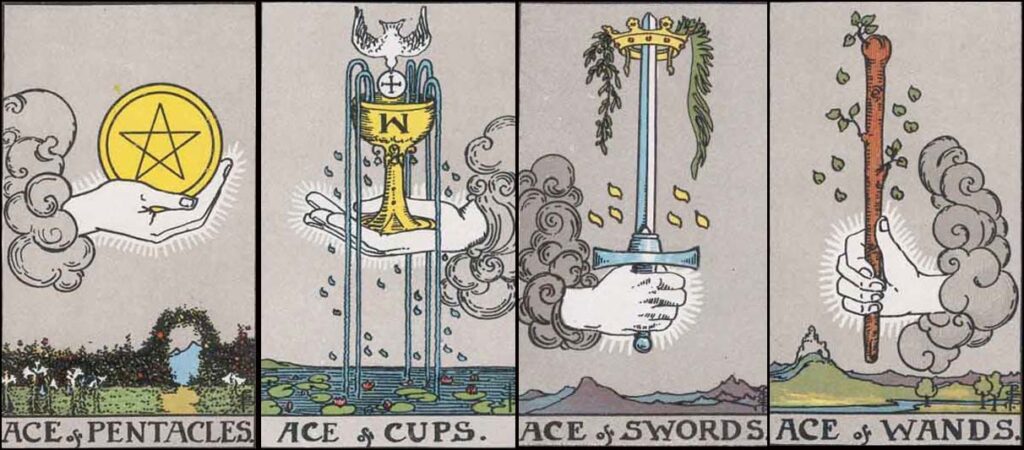
For a quick review, and for the purposes of this exercise, here is my interpretation of the suits:
Swords are intellect and conflict. They rule over the mind, words, dialectics, limitations, and the classical element of air.2
Wands are ideation and creation. They rule over the creative process, ideas, the future, the spiritual, and the classical element of fire.
Cups are emotion and relationship. They rule over feelings, friendships, family, collaboration, culture, and the classical element of water.
Coins are material and practical. They rule over finance, the house, work, society, the day-to-day, and the classical element of earth.
Constructing Verb-Noun Phrases
Using the verb of the role and the noun/theme of the suit, we can synthesize each court card into a simple phrase. Here is an example of how this might be done:
| Pages | Knights | Queens | Kings | |
| Swords | beginning thought | changing thought | nurturing thought | controlling thought |
| Wands | beginning (to learn) ideas | changing ideas | nurturing ideas | controlling ideas |
| Cups | beginning relationship(s) | changing relationship(s) | nurturing relationship(s) | controlling relationship(s) |
| Coins | beginning material life | changing material life | nurturing material life | controlling material life |
Look at these phrases and consider the type of person, or role, that has this behavior. We can synthesize new titles for the court cards in this way. For example, consider the Page of Swords: someone who is beginning thoughts, that is: learning. Or, put more simply: a student.
Here is an example of this final step.
| Pages | Knights | Queens | Kings | |
| Swords | student | activist | teacher | politician |
| Wands | dreamer | artist | philosopher | author |
| Cups | youth | lover | parent | therapist |
| Coins | seed | worker | gardener | treasurer |
These titles can definitely tend toward the metaphorical. Consider what it means for you to step into the role of treasurer (King of Coins). This likely does not mean that you are literally going to entertain a treasury career; instead, consider how you might control your material wealth and day-to-day, and what kind of material impact you have on yourself and on others.
An additional example: stepping into the role of parent (Queen of Cups) does not necessarily mean that you are literally a parent. It could also mean that you are emotionally supporting someone in an unequal (not necessarily bad) way, or indicate a relationship of care.
Play with the nouns, verbs, and synthesis until they bring to mind a role that you have seen in life. If your idea of someone who “nurtures ideas” looks nothing like a philosopher (Queen of Wands), identify someone else who nurtures ideas in your life: An art teacher, a professional mentor, a muse that inspires you. If you find it difficult to connect to the idea of “nurturing,” or read a stronger theme into the suit for yourself, instead try another verb, like “mediating,” “influencing,” or “intuiting.” Experiment with these patterns until you find a system that gives you a holistic understanding of the court cards.
Final Notes
When using the court cards in this way, try not to immediately assume that the cards represent external people when doing a reading for yourself. Instead, analyze the roles as roles you could fill. We all have the capacity to be youths and parents, workers and rulers, in different ways and in different aspects of our lives. Court cards can be very flexible with very permeable meanings, and this is one of their strengths.
There are many other ways to interpret court cards, and this is just the one that I’ve used personally to explain to novices how to start understanding the deck systematically. I am by no means saying that this is the only method you can use, and in fact it isn’t even the only method I use. Tarot is a wealth of symbolism and meaning. My goal is only to offer these ideas to provide a working, functional knowledge.
Any system of knowledge will grow with time and experience. You will find that certain cards mean certain things for specific contexts but not others. You may find that certain court cards become indicator cards (representatives of you or people or spirits close to you). Your understanding may change with time. That’s not only fine but to be expected.
- Some traditions switch swords and wands, i.e. swords would be fire and wands would be air. Use the King of Wands and Knight of Swords if your elemental associations are switched. ↩︎
- Ibid. ↩︎
All Rider-Waite-Smith tarot images were illustrated by Pamela “Pixie” Colman Smith and are public domain.