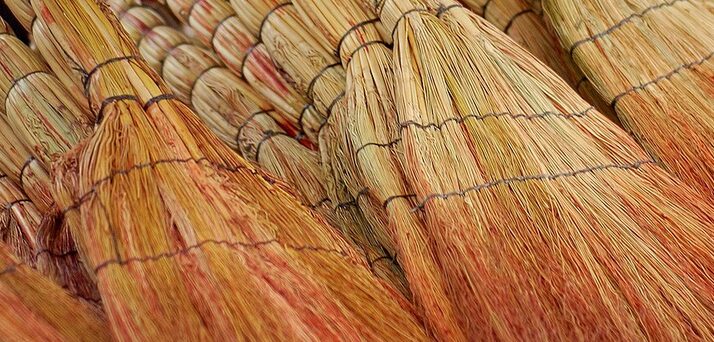
This week, since I’m drawn to the domestic in busy times, I’ve been focusing quite a lot on working the broom. Perhaps because of its strong association with the image of the “Halloween witch,” the broom is a tool that I believe to be one of the least understood in folk magic.
The broom’s accessibility and cross-cultural use make it very grounded very strongly in domesticity and functional purpose. They are quite literally used to clean and decontaminate a space.
In Deitsch tradition, the broom does not just sweep dirt but can mediate the relationship between a family and a new home, sweeping in unseen currents such as family luck as well as sweeping out unwanted ones. In contemporary Urglaawer publication Hollerbeer Hof, Spring 20241, Rob Schreiwer describes a Deitsch tradition of using the broom to claim the home:
In some areas, the arriving family would send ahead, often at dawn, a broom from the old location, and one of the family members (traditionally the eldest daughter who will reside in the home) would sweep all of the thresholds and entrance areas. Since the departing families usually would sweep the home prior to leaving, there seems to be a ritual element to the practice. The sweeping started from outside of the new home and worked its way inside, beginning at the main threshold into the home, where the sweeper would begin to “claim” the house, threshold by threshold. Accumulated dust and dirt would be disposed of, as needed, by leaving the broom in the claimed area and taking the dirt through the unclaimed area to a bin placed by the exit from the home closest to the last area that was to be claimed, which was usually the kitchen.
The ritual sweeping would then go throughout the home, always claiming an area of the threshold into the room but then sweeping outward. An exception would be if the room had two thresholds. In that case, the sweeping of the first threshold would be inward, claiming the room, and the second threshold would be outward, in order to claim what is on the other side.
If the house had only one threshold to the outside, a way would have to be devised to have the final inside area be as close to that door as possible (note that this conflicts with the superstition that it is bad luck to enter the house through one door and to leave through another). If it had more than one threshold, then one was to be chosen (preference going to the kitchen, if possible) to be the point of disposal outside of the home.
Interestingly, although one can see clear ties to other forms of ritual sweeping to remove unwanted energies (and that always plays a role, at least as a subtext), the most commonly cited purpose is to ward off homesickness or other senses of loss that might result from the move.
The broom, being the first of a family’s possessions to enter a new home, becomes its mediator and helps establish proper order. The house is made livable for the family and its thresholds are firmly acknowledged and defined; meanwhile, the family not only imposes its daily life (in the form of housework) upon the new space but also literally carries the dust of the old home with it into the new home.
Likewise, in Powwowing in Pennsylvania: Braucherei & the Ritual of Everyday Life, folklorist Patrick Donmoyer writes2:
According to beliefs held even by some in the present day, the household broom, when leaned against the jamb of the front door, or concealed below the threshold, has the capacity to protect the home from anyone wishing spiritual harm upon the occupants. […]
The broom represented the home, and had direct contact with the dust in the home, created by everyday activities. This dust was believed to carry some measure of the essence of the house and family, which fostered a wide range of beliefs surrounding the cleaning of the home. […] The old broom was customarily the first item placed into a new home, as it brought with it some measure of the essence of the previous dwelling place and established a sense of domestic continuity.
[… T]he dust from the home was believed to have important useful properties. It was once common to take dust from the four corners of the house and to mix a tiny bit into your coffee or into the flour used to bake bread before one embarked on a long journey in order to avoid homesickness. The person who partook of the coffee or bread was therefore taking the home’s essence into their body in order to fortify them against pining for home while away. This type of integrated belief made manifest in domestic ritual lends a whole new level of meaning to the activities of daily life, and links everyday tasks to a broader sense of cosmic order.
The qualities of a family (such as its essence or its luck) are therefore imposed upon a space by living in it and creating the dust which the broom rules over. Put more simply, the dust a family creates is the family.
While the broom is contemporarily associated with witches, like so many things, it is also associated with protection from witchcraft, as in e.g. the Italian belief that a broomcorn broom hung behind the door would deter witches3, which can be tidily likened to the Deitsch tradition of leaning the broom against the door jamb or hiding it under the front threshold. Its threshold association extends also to its extensive cross-cultural association with weddings4, its stick representing a threshold of domesticity that can both literally and figuratively be crossed when laid on the ground.
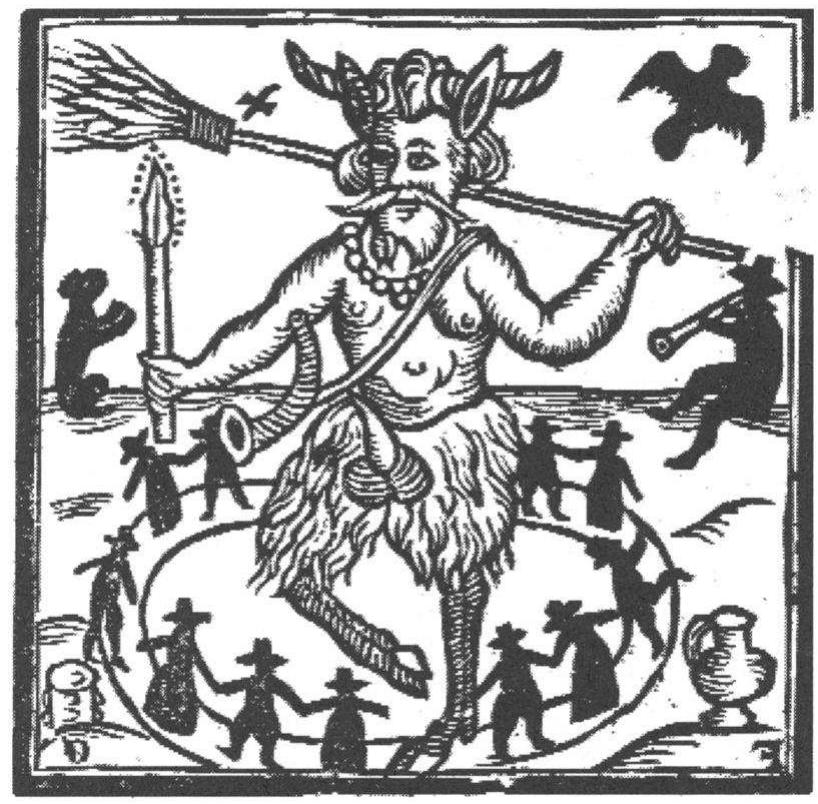
There is also a complex relationship between the broom as a symbol of domestic, rural “vulgar” life and its association with equally “vulgar” spirits, e.g. fairy and folk belief contrasted with institutionalized Christianity; consider the role of the brownie, the hobgoblin, the domovoi, and their analogues. For example, in the English folklore of the 1500s and 1600s, fairies were associated with a low or country class and considered transgressors of boundaries. In “Why Does Puck Sweep?: Fairylore, Merry Wives, and Social Struggle,” Wendy Wall writes5:
I suggest that two aspects of fairylore blended in the cultural imagination: domesticity and a “low” country workforce defined in patent opposition to the court or the site of humanity “high” learning [… and] the fairies’ interest in sexual, as well as class, trespass. […] Whether protecting honor or provoking desire, fairies surface as gatekeepers to an explicitly sexualized and work-centered world.
[…] Robin Goodfellow is defined by both domestic and sexual escapades. In this woodcut, Robin appears as a gigantic bearded satyr with hairy breeches and hoofed feet, holding a priapic scepter in one hand and a broom in the other.
From these traditions there are several identifiable occult powers of the broom, among them its quality as a threshold and its ability to claim space; its rulership over (and potential to subvert) boundaries; its ability to control the quality of a space, by controlling the movement of dust and dirt, bringing helpful or harmful qualities in or out; and its ability to mediate the domestic relationship between home and family.
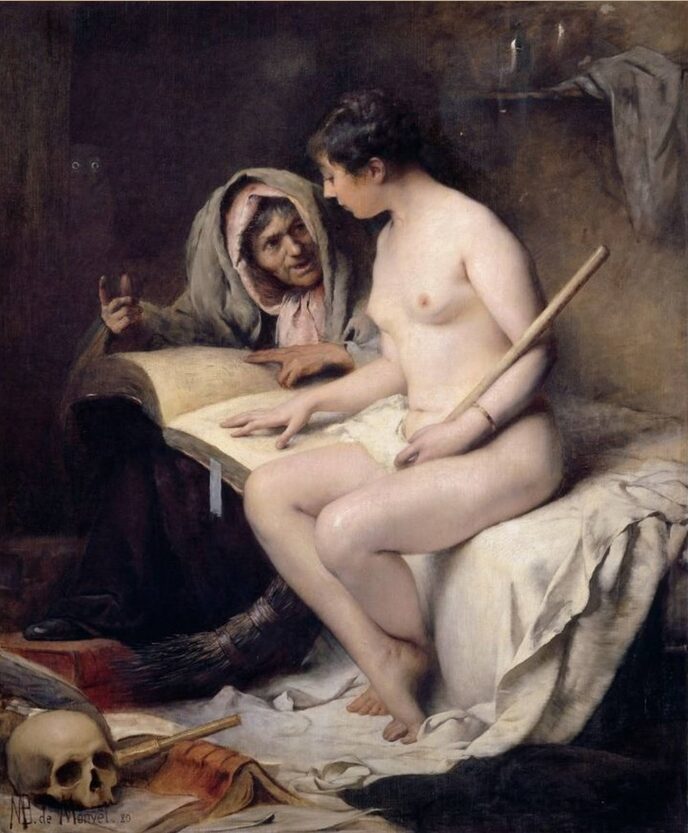
The broom’s power over thresholds and movement are (along with the association between witchcraft, women, and the domestic) part of the reason a broomstick can be used for witches’ sabbaths and spirit flight. By placing one foot on either side of the broom, one literally straddles the threshold, entering liminal space.
Broomcorn
I grew up with my mother’s natural broom, but in my adult life every broom I ended up with was plastic and polyfiber. I don’t like to work with plastic if I can help it, so it took a while to find a broom I could really work. It is a lightweight broomcorn (Sorghum bicolor) broom, undyed, with red binding on a pine stick-handle. It’s quite small, which suits me just fine.
Much has been said about the qualities of pine. Less well-known is sorghum, a plant used by prehistoric peoples as early as the Pleistocene6 before being domesticated from wild sorghums in Sudan in ~3500 BCE7, but has indigenous spiritual significance and associated tradition as far afield as Australia8, and which today is used prominently for both human and livestock consumption. Despite this, sorghum only became a commonplace broom material in Massachusetts in 17979, after which sorghum became a cash crop and the contemporary “flat broom” style was developed, giving sorghum the colloquial name “broomcorn.”
Broomcorn is a strong ally to the home. Being a grain, it is associated with bread, the harvest, and all of that associated fertility cult power, and is one of our most ancestral plant allies; being a broom-plant, it is sweeping, cleansing, harnessed more for its physical properties than chemical, like a sister to flax. Flax is one of the only founder crops10 cultivated in the Levant meant not just to eat but to construct (namely linen) and is associated with various weaver goddesses, most relevantly Frau Holle and Perchta11, who are said to have taught the skill of spinning flax and who punish errant spinners. Weaving and its associated tools, such as the loom and distaff, have power over both the domestic realm and with fate (especially given that welfare in the domestic realm frequently has much to do with quality of life and final fate in any society).
These are the powers underlying the broom. Like the distaff and spindle once were, the broom is a commonplace domestic tool, which belies its power. By keeping proper order in the domestic realm we can turn that power to our own advantage, and turn our fate.
Working Broom and House
I lived in this house before I owned the broomcorn broom, and my partner lived in this house before that, so my broomcorn broom certainly was not the first item to enter the home in the Deitsch tradition. However, my work with the broom is somewhat analogous.
As I’ve discussed previously, when I bring new things into the home, especially spiritual objects, I like to introduce them to the house and its spirits to ensure a smooth transition and so that all of my tools and spirits will work with each other nicely. This goes double for the broom, the domestic mediator and staff of power over the home; it necessarily cannot mediate between house and dweller without the permission and participation of both. So the introductory work is vital.
I began by physically cleaning the broom, removing any labels, and telling it its purpose. For several days it rest upright by the home altar (so that I could add this to my list of daily altar chores), broom end to the ceiling; I have been told it is good luck to rest it this way and bad luck to rest it in the reverse, though (like many similar luck-related pieces of advice) this is likely to simply be functional information on how best to care for a corn broom.
I anointed the handle, very gently. Broomcorn has a subtly sweet smell that I did not want to overpower. The enlivening oil in this context is like a call to the spirit of a thing and a method of feeding and empowering it. With help and direction, it draws the spirit out and enlivens an object to its purpose. There are other approaches and formulas for this sort of thing, and this isn’t even necessarily my preferred one; suffumigation might be a better choice for a broom for several reasons, namely the lightness of some smokes and its ability to permeate the bristles.
Thus awakened, I introduced the broom to the house by working the whole house with it. Starting with the front door, I worked my way into the house, sweeping in fortunes and sweeping out troubles (and a lot of pet hair). I swept the entire upstairs, taking each threshold, then ended in the kitchen where all of the unwanted dust and debris was finally taken out. Along the way, I speak not just to the broom but to the house, teaching the broom how it can keep balance between us. I show the broom where I have trouble keeping order: See this corner where the pets eat and it’s hard to clean? See this closet where clothes tend to pile up? and so forth. I introduce the broom to the flow of our lives, that which belongs in the house and that which does not, and acquaint it with the boundaries by tracing them, and when the work is done it is anointed as both partner and independent actor. Home spirits do not necessarily need payment for the keeping of order in the home, because it is in their nature, but I will care for the broom and ensure its longevity, as I would any enspirited object in my care.
Simultaneously, its value as mediator is demonstrated to the house spirit. Beyond the functional use of the broom, having the broom in my hand transforms me from a normal person into the domestic ruler and caretaker. It gives the holder different eyes to see and address dirt and disorder, and places me in a position where my foremost thought is caring for the domicile. Like many tools, mindfully holding the broom is a subtly transformative action. Sweeping becomes a meditative act of care.
I am fascinated with the role brooms typically play in contemporary witching spaces. They are typically relegated to little more than symbols: a decorative object. Most often I see them used as symbols of spirit flight, which is a powerful application of the broom-as-threshold, but is by no means the extent of the power of the broom, especially not in folk magic. Brooms relegated to symbolhood are often completely nonfunctional, with decorations that get in the way and even dyes that will leach if the broom is ever actually used.
My broom now has a place hanging on the wall beside the front door. It has a guardian threshold-spirit, a watcher. It controls what flows in and out, empowers the house-spirit, protects the family, and is available as a fate-spinning, oath-taking, or world-bridging tool should the need arise. But don’t be confused: I take it down far more often simply to sweep. The daily life is the magical fabric that the broom works upon. It is not a tool to be set aside and left unused.
- Schreiwer, Rob. (2024). “Upcoming Events and Observances: Der Ziegdaag.” Hollerbeer Hof Spring 2024 (Vol. 17, Issue 1). ↩︎
- Donmoyer, Patrick J. (2017). Powwowing in Pennsylvania: Braucherei & the Ritual of Everyday Life, p. 261-2. ↩︎
- Nedelcheva, A. M., Dogan, Y., and Guarrera, P. M. (2007). “Plants traditionally used to make brooms in several European countries.” Journal of Ethnobiology and Ethnomedicine (Vol. 3, No. 20). Available on PubMed. ↩︎
- Jumping or crossing the broom as a wedding tradition is documented in England, Ireland, and Wales, e.g. among the Romanichal and Kale, as well as in American diaspora. For a start, review Parry, Tyler D. (2016). “The Holy Land of Matrimony: The Complex Legacy of the Broomstick Wedding in American History.” American Studies (Vol. 55, No. 1). Available on JSTOR. ↩︎
- Wall, W. (2001). “Why Does Puck Sweep?: Fairylore, Merry Wives, and Social Struggle.” Shakespeare Quarterly (Vol. 52, No. 1). JSTOR. ↩︎
- Mercader, J. (2009). “Mozambican Grass Seed Consumption During the Middle Stone Age.” Science (Vol. 326, Issue 5960). Original. ↩︎
- Winchell, F., Stevens, C. J., Murphy, C., Champion, L., and Fuller, D. Q. (2017). “Evidence for Sorgum Domestication in Fourth Millenium BC Eastern Sudan: Spikelet Morphology from Ceramic Impressions of the Butana Group.” Current Anthropology (Vol. 58, No. 5). DOI. ↩︎
- Arndt, W. (1961). “Indigenous Sorghum as Food and in Myth: The Tagoman Tribe.” Oceania (Vol. 32, No. 2). JSTOR. ↩︎
- Nobles, G. H. (1984). “Commerce and Community: A Case Study of the Rural Broommaking Business in Antebellum Massachusettes.” Journal of the Early Republic (Vol. 4, No. 3). JSTOR. As an incidental note, the “discovery” of sorghum brooms’ profitability rapidly changed broom-making from “low work,” “fit” for the disenfranchised Native population, to white men’s work, excluding women as well. This is a notable twist on the broom’s role as domestic mediator, a realm which (in this time and place) was the work of women and the disenfranchised. ↩︎
- Originally a set of eight early domesticates proposed by Zohary and Hopf in 1988, contemporary research has expanded the list to somewhere between approximately twelve and twenty species. For more information see Fuller, D. Q. et al (2012), “Early agricultural pathways: moving outside the ‘core area’ hypothesis in Southwest Asia,” Journal of Experimental Botany (Vol. 63, Issue 2). Oxford. ↩︎
- Urglaawers hold that they are sisters, while other Germanic traditions commonly see them as regionalisms of one another. ↩︎
The featured image is of brooms for sale in a Tbilisi market from “It’s all about cleanliness” by Vladimer Shioshvili.
