Lydia Vvinters recently put forward the question1: Does the work of divination indicate that the universe is predestined or deterministic? This is a great question, and I think that it’s actually easier to start outside of the realm of magic and divination and look directly to philosophy.
Causal Determinism
I subscribe to a causal deterministic2 view of the universe, where all occurrences are both cause and effect.
Causal determinism is distinct from other forms of determinism such as predestination, a theological idea which supposes that divine forces (God, gods, etc.) have already determined all outcomes, including the destination of any given individual’s human soul. Causal determinism proposes instead that every event is caused by antecedent events and natural laws.
I think that this can be a bit heavy for people unfamiliar with philosophy, so my favorite articulation of the idea is Laplace’s demon, described by Pierre-Simon Laplace. He proposes that if there were an intelligence (the demon) that knew the location and momentum of all particles in the universe, it could accurately predict all future events. Put simply: The reason we cannot flawlessly predict all events is due to a lack of information.
Brought into our lived context, consider my partner’s favored example: Am I going to eat a pizza tonight? Causal determinism holds that if you eat a pizza, it is because you were making a choice based on your personality, your prior choices, your environment, and your circumstances. Your personality and prior choices all come about because of your past, your culture, your genetics, your community, and near-infinite other microfactors. And your culture came to be because of a million trillion microfactors, and the pizza came to be because of market and culture and tradition which all came to be because of so many microfactors, and your genetics came to be due to an uncountable number of incremental evolutionary changes, all the way back to single-celled organisms, back to the genesis of life, back to the Big Bang3… which is certainly overwhelming to consider when you’re wondering if you want to eat pizza.
Divination and Magic
Divination can change so much depending on the user and the technique. It does not seem on the surface to be too difficult to define divination, but even in small circles my fellow diviners cannot even seem to agree on if the future can be predicted and, if so, to what extent4.
For the purposes of this discussion, let us say that divination is any technique that gives the ability to discern unknown information. The unknown information may be the future; it may be the details of some event for which you were not present; it may be (as often seen in grimoires of antiquity) the location of treasure. The goal regardless is the acquisition of information.
From the causal deterministic perspective, all events are the result of prior conditions, events, and laws. Like Laplace’s demon, if we only had all of this information and the capacity to meaningfully process it, we too could predict the future. The goal of divination through this lens, then, is to sort through this extensive data–every influence and thread–and parse it into meaning that we can actually understand.
This is a translation process that is not without flaws. Tarot, for example, is effectively a vocabulary with seventy-eight words, making it an extremely limited language. We can expand upon the possible meanings of this vocabulary by providing context in the form of specifically-directed queries and placements, but the tool still has limits. If we consider forms of divination without explicit output limitations, like trancework, there are still limits in terms of what and how much the human brain can parse out and how we receive our information, e.g. through vision.
However, using divination and our intuition, we can trust that we are pulling on the threads (past events and influences) that will most meaningfully affect the outcome5. In short, we are dipping into the vast database of Laplace’s figurative demon and predicting an outcome–but with our flawed human viewpoint, abilities, intuition, and biases.
There is a meaningful addendum to this: Many spirit-workers, as I am, do not explicitly only use the self to mediate meaning out of the cards, but specifically address an assistant-spirit. I know of several witches that address the higher-self, spirit-self, genius, or equivalent. I know of several diviners, especially folk witches and spirit-workers, who work with familiar or divinatory spirits as an intermediary to refine the cards. These spirits can impress their own opinions and judgement onto the output, but can also sometimes do a better job of parsing through the influences than we can, depending on the circumstances.
This brings me to magic. Divination does not exist in a void, and for the majority of magical practitioners, it is a tool, not a whole practice on its own. It is frequently used to research workings, predict the outcome of workings, and communicate with spirits. In such cases, divination is not just reactive information-seeking but can cross the line into a proactive attempt to influence the future. I use certain divinatory techniques that are both in one: First laying out the future before me, then giving me the direct magic threads to pull upon to shift it.
Perhaps magic is, in part, our ability to work to influence the work of the weavers6. The compatibilist view is that, though we live in a causally determined world where the great fabric is being woven, we, as the loose threads at the end of the cloth still being woven, still have a form of free will. Magic is one such exertion of free will.
- Lydia Vvinters, AKA @HeliaXyana@mastodon.nl, runs the prompts for #Fedicoven, a fediverse-local discussion prompt series. This question is 2026 Q1. Thank you to Lydia for the prompt and the great discussion. ↩︎
- I am more technically a compatibilist, but I am not trying to overwhelm the casual reader with philosophical theses. ↩︎
- The most compelling criticism of causal determinism that I have ever heard is the problem of the Big Bang, which is to say that we do not know what caused the Big Bang or what came before it. Even if we did, what came before that? The action-reaction model implies that there must have been a “first action.” ↩︎
- Saying that divination categorically cannot predict unknown reality or the future is, in my view, a losing position. Similar to the adage that belief in one’s own magic gives it [more] power, it is advantageous to start from the viewpoint that divination is capable of predicting or seeing anything and then refining your beliefs based on results. On the other hand, some people do divination without believing in magic at all and use it purely as a reflective tool, which is not what is being discussed here. ↩︎
- For this reason, you will frequently see in my tarot spreads that I allocate positions for past influences and events. This gives explicit context to the rest of the reading. ↩︎
- Used here generally or colloquially but could also mean, e.g., Fortuna, Frau Holle, Frau Perchta, the Fates, the Norns, et al. ↩︎
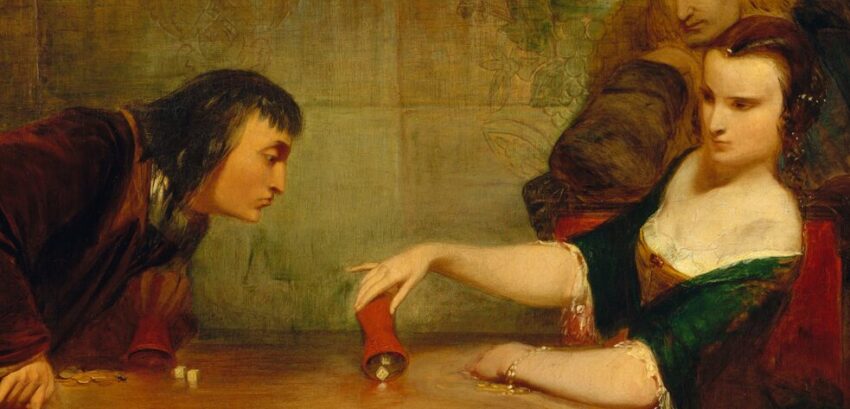
Featured image is from Charles Robert Leslie’s “The Last Throw”.